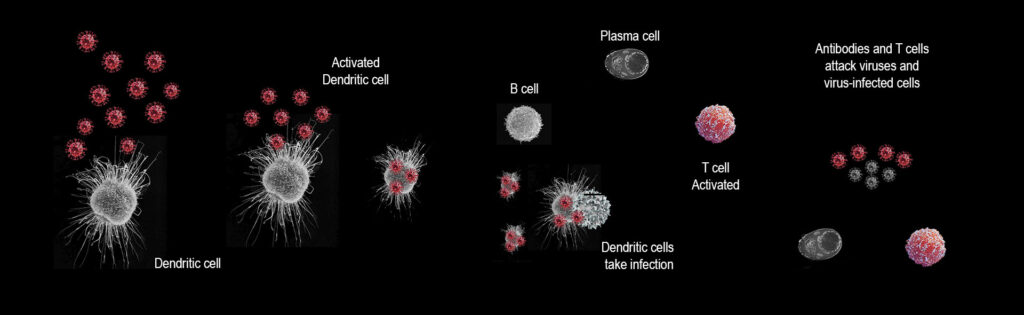
Dendynamics is an innovative company at the intersection of artificial intelligence (AI) and life sciences, focusing specifically on dendritic cells—crucial immune cells that are essential for initiating and regulating the body’s immune responses.
The company aims to harness its expertise in dendritic cell biology alongside advanced computational techniques to create groundbreaking treatments and diagnostics for various diseases. By leveraging machine learning and other AI technologies, Dendynamics analyzes complex biological data, formulates novel therapeutic strategies, and develops personalized medical approaches tailored to individual patient needs.
Dendritic cells are a cornerstone of the immune system, serving as professional antigen-presenting cells (APCs) that orchestrate both innate and adaptive immune responses. Their unique ability to capture, process, and present antigens to other immune cells enables the body to detect and combat pathogens efficiently.
Named for their tree-like (dendritic) appearance, these specialized white blood cells act as sentinels, constantly surveilling the body for potential threats. Their functions are as diverse as their structure, playing critical roles in immunity, tolerance, and inflammation management.
Structure and Characteristics
Dendritic cells are distinct in morphology and functionality:
Appearance: They feature large cytoplasmic projections, resembling nerve cell dendrites, which aid in detecting invading pathogens.
Cytoplasmic Composition: While devoid of filaments, their cytoplasm contains mitochondria, Golgi complexes, and diverse granules such as melanin granules.
Maturation Stages: These cells transition between immature and mature forms, adapting their roles based on environmental signals and pathogen presence.
Immature dendritic cells patrol peripheral tissues, capturing antigens but displaying limited antigen-presentation capabilities. Upon activation by pathogen-associated molecular patterns (PAMPs) or inflammatory signals, they undergo maturation, enhancing their antigen-processing machinery and initiating immune responses.
How Dendritic Cells Fight Pathogens
Dendritic cells bridge the innate and adaptive immune systems. They detect and process antigens, then migrate to lymphoid organs to activate T cells and other immune components. Key processes include:
Antigen Processing and Presentation:
They process captured antigens and present them alongside MHC molecules to T cells.
This interaction drives the activation and differentiation of T cells into specialized subsets.
Innate Immune Functions:
Early in infections, dendritic cells produce cytokines like IL-2 and IFN-γ, activating natural killer (NK) cells and boosting innate immunity.
They enhance NK cells’ cytotoxic functions, contributing to rapid pathogen clearance.
Through «cross-presentation,» they can initiate immune responses to intracellular antigens, crucial for antiviral immunity.
Types of Dendritic Cells
Dendritic cells are highly diverse, comprising several specialized subsets with distinct roles in immunity:
Plasmacytoid DCs (pDCs):
Resembling plasma cells, pDCs produce large amounts of type I interferons, playing vital roles in antiviral immunity.
Conventional DCs (cDCs):
Subdivided into CD8α+ and CD11b+ cells, these DCs specialize in priming CD8+ and CD4+ T cells, respectively.
Migratory DCs:
Found in tissues like skin and gut, these cells transport antigens to lymphoid organs, linking peripheral detection with systemic immunity.
Monocyte-Derived DCs:
Formed during inflammation, these DCs emerge from monocytes and provide rapid protection during bacterial infections.
Unique Features of Dendritic Cells
Antigen Presentation Expertise: Dendritic cells excel in presenting antigens to T cells, ensuring precise immune responses.
Immune Tolerance: They maintain tolerance by preventing T-cell activation against self-antigens under normal conditions, reducing the risk of autoimmunity.
Polarized Immune Responses: Based on surface receptors, dendritic cells direct appropriate immune responses tailored to the nature of the invading microorganism.
B-cell Activation: They form temporary clusters with B cells, promoting antibody production and humoral immunity.
Functional Transition: Immature to Mature
Dendritic cells undergo significant changes during maturation:
Loss of adhesive structures and cytoskeletal reorganization.
Increased motility and migration to lymphoid organs.
Elevated expression of MHC-II and costimulatory molecules for efficient T-cell activation.
Reduced endocytic activity, focusing energy on antigen presentation.
Roles in Immunity
Adaptive Immunity: Dendritic cells are central to activating T cells, driving antigen-specific responses, and orchestrating the differentiation of helper T-cell subsets.
Innate Immunity: Beyond adaptive roles, they play early-response roles by activating NK cells and producing cytokines that shape the initial immune defense.
Regulatory Control: They influence regulatory T cells, balancing immune activation with tolerance to prevent unnecessary inflammation.
Dendritic cells are essential to the immune system’s ability to identify, adapt, and respond to threats. As sentinels of the immune system, they not only defend against pathogens but also maintain balance, ensuring the body differentiates between harmful invaders and self-tissues. Their unique adaptability and multifaceted roles make them a cornerstone of both immunity and tolerance, and a focal point for advancements in immunotherapy and medical research.